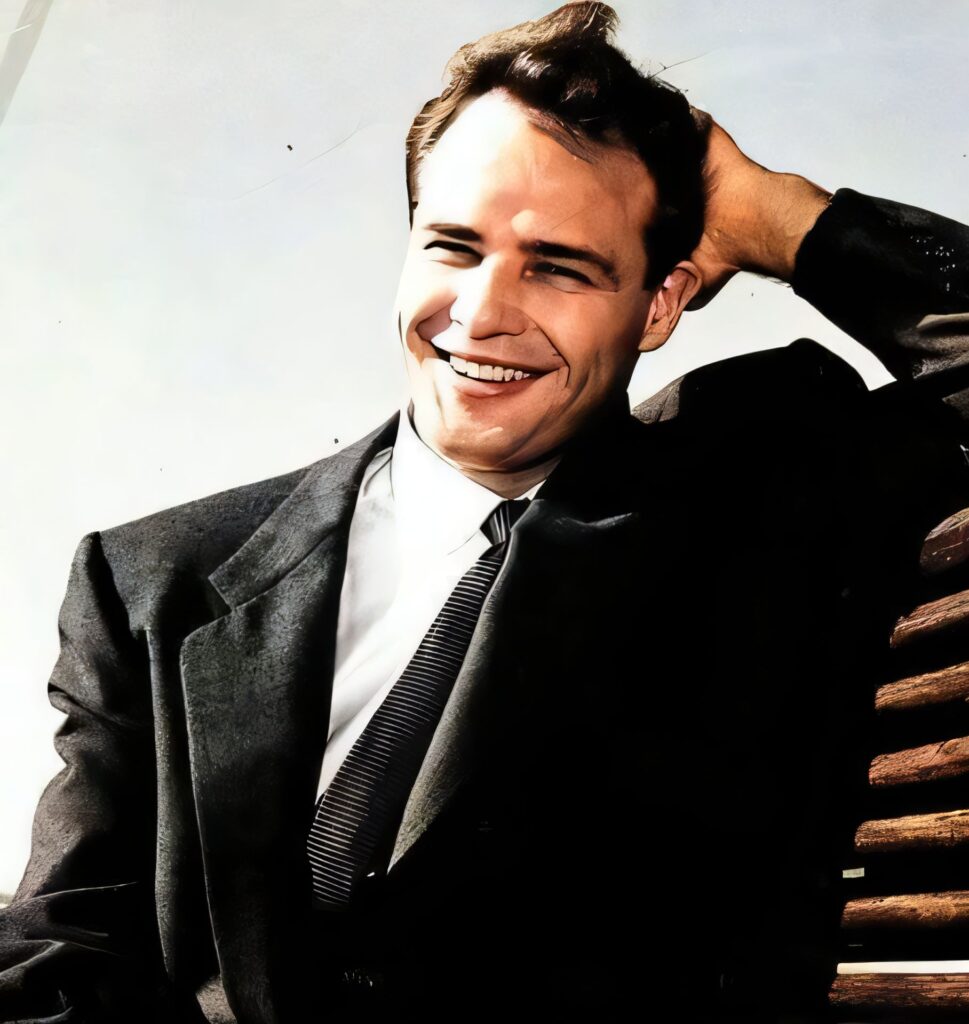
Marlon Brando remains one of the most influential actors in film history.
He changed the way audiences understood realism on screen.
He also reshaped what Hollywood expected from leading men.
Brando’s life was full of genius, conflict, reinvention, and controversy.
This long-form profile explores his career, his signature acting style, his landmark films, and his cultural legacy.
It also looks at the tensions between his artistry and his personal choices.
Along the way, you will find practical context, memorable moments, and critical insights that keep the story entertaining and meaningful.
For readers who want to explore further, you will also see selected links placed where they naturally fit.
Early Life and the Roots of a Rebel Persona
Marlon Brando was born in 1924 in Omaha, Nebraska.
His childhood was marked by instability and emotional distance.
His father was often described as strict and difficult.
His mother was talented and socially active, but her struggles affected the family.
These early pressures helped form Brando’s complicated relationship with authority.
They also contributed to the inner tension that later appeared in many of his performances.
Brando did not begin his path as a polished Hollywood product.
He moved through school with mixed results and frequent friction.
His early reputation was not built on discipline.
It was built on raw personality.
That rawness later became an advantage when acting styles started shifting toward realism.
If you want a quick overview of his filmography and awards, you can start with his listing on Britannica.
Brando eventually found his way to New York City.
There, he discovered the serious world of theater training.
This was not just a career step.
It was the beginning of a new type of American acting.
The Method Acting Revolution and Brando’s Signature Style
Brando is closely linked with Method acting, even though the full history is more complex than a single name.
He trained with influential teachers who valued emotional truth, psychological depth, and behavior that felt lived-in.
Rather than “performing” a character in a traditional theatrical way, Brando seemed to inhabit the character.
This approach changed audience expectations.
It also changed the expectations of other actors.
Brando’s acting often looked casual, but it was rarely simple.
He used silence as power.
He used pauses as meaning.
He used physical movement like punctuation.
His voice could be soft, sudden, or barely controlled.
That unpredictability created tension, even in calm scenes.
His characters often appeared to be thinking in real time.
That sense of inner life became one of his trademarks.
This was especially important in the mid-20th century, when Hollywood still leaned toward polished delivery and clear theatrical projection.
Brando did not reject technique.
He redirected technique toward natural behavior.
To understand how central he is to American screen culture, it helps to view his place in the broader history of film.
You can explore that wider context through the American Film Institute.
Broadway Breakthrough: The Stage Before the Screen
Before he became a film legend, Brando made major waves on Broadway.
The stage gave him room to experiment with intensity and vulnerability.
It also placed him in environments that valued daring choices.
In those early years, people did not just praise him as “talented.”
They described him as disruptive.
He was the kind of performer who made other actors adjust their rhythm.
He was also the kind of performer who made directors rethink what was possible.
The theater world recognized something new.
Brando did not seem to be imitating emotion.
He seemed to be living inside it.
That reputation moved with him into film.
It also created high expectations.
Hollywood often punishes high expectations.
Brando, however, had the rare ability to exceed them.
Hollywood Arrival and the Shock of Realism
When Brando entered cinema, his presence felt modern.
He did not look like a classical studio-made star.
He looked like a person you might actually meet.
Yet he also carried a kind of danger.
That danger was not always violent.
It was emotional.
It was sexual.
It was unpredictable.
This “new masculinity” became central to his early screen persona.
He represented desire, anger, charm, and insecurity at once.
That mixture made him magnetic.
It also made him hard to manage for traditional studio systems.
Brando’s rise coincided with a moment when American culture was changing.
Post-war anxiety, shifting gender roles, and social pressure created an appetite for more honest stories.
Brando fit that appetite perfectly.
Landmark Role: A Streetcar Named Desire
One of Brando’s most iconic roles is Stanley Kowalski in A Streetcar Named Desire.
The character is forceful, charismatic, and brutally human.
Brando’s performance was not simply “strong.”
It was psychologically sharp.
It exposed how cruelty and charm can exist in the same person.
It also showed how power can be social, sexual, and physical at once.
Many viewers remember the loudest moments.
Critically, the quieter moments matter just as much.
He gave Stanley a sense of instinct.
He made the character feel driven by appetite rather than ideology.
This performance helped define Brando’s early legend.
It also helped define a new level of intensity in American film acting.
For background on the film and its place in cinema history, you can browse film summaries and credits on TCM.
On the Waterfront: Career Peak and Cultural Symbol
If one performance often stands as Brando’s greatest, it is Terry Malloy in On the Waterfront.
This role combined vulnerability with suppressed rage.
It also balanced personal tragedy with social conflict.
The famous scene about “being somebody” became a defining moment in American cinema.
It worked because Brando did not play it as a speech.
He played it as a wound opening.
The film itself sits at the intersection of art and politics.
That matters because Brando’s career repeatedly collided with political meaning.
The story focuses on corruption, unions, fear, and moral courage.
Brando’s performance turned those themes into personal experience.
He made ethics feel intimate.
He made failure feel physical.
His Oscar win for this film confirmed his dominance.
Yet it also intensified the pressure that came with being “the greatest.”
Brando’s Star Power and His Resistance to Hollywood Rules
Brando was a star, but he often acted like he did not want to be one.
He challenged studios.
He argued with directors.
He questioned scripts openly.
He sometimes appeared bored with publicity.
This resistance became part of his brand, even when it hurt him professionally.
Hollywood likes rebellion only when it can be packaged.
Brando’s rebellion was not always easy to package.
He did not consistently play the game.
That made him both admired and criticized.
In some years, his career looked unstoppable.
In other years, it looked chaotic.
This unpredictability is part of what keeps Brando interesting.
He was not simply a success story.
He was a story of constant tension between talent and temperament.
For a broader look at Hollywood’s studio-era structure and how it shaped stars, the Academy Museum provides helpful background.
The Reinvention: The Godfather and the Power of Transformation
By the early 1970s, some observers thought Brando’s best years were behind him.
Then came The Godfather.
His portrayal of Vito Corleone became one of the most studied performances in cinema.
It was quiet, controlled, and filled with detail.
It was also physically transformed.
His voice, posture, and stillness created authority without constant movement.
He made power look patient.
He made danger look calm.
This is one reason the performance remains so influential.
It showed that dominance does not require volume.
It requires presence.
Brando’s work in The Godfather also proved he could adapt.
He could move from youthful volatility to elder gravity.
He could become mythic without becoming artificial.
If you want to explore the film’s continuing impact and production details, Paramount Pictures is a useful starting point for official background.
The Oscar Refusal and a Turning Point in Celebrity Activism
Brando’s decision to refuse his Oscar for The Godfather became one of the most talked-about moments in awards history.
He used the occasion to protest the film industry’s treatment of Native Americans.
Instead of attending, he sent a representative to speak.
The moment was dramatic.
It was also divisive.
Some praised the act as brave and necessary.
Some criticized it as self-serving or inappropriate for the setting.
A fair reading acknowledges both the significance and the complexity.
Brando brought a major political message into a mainstream entertainment ritual.
That choice helped normalize a later pattern.
Actors today often use public platforms for advocacy.
Brando’s act was an early high-profile example.
To better understand ongoing media discussions about representation, you can explore resources from Smithsonian collections and essays that address American cultural narratives.
Last Tango in Paris: Art, Scandal, and Ongoing Debate
Another major Brando film, Last Tango in Paris, remains controversial.
It is often discussed for its emotional rawness and explicit content.
It is also discussed for ethical debates around production practices and consent.
This is where any serious Brando article must slow down.
Great acting does not erase real-world harm.
Cultural influence does not remove responsibility.
Brando’s legacy, like the film’s legacy, includes both artistic impact and troubling questions.
It is possible to acknowledge the performance’s importance in film history while also taking the ethical criticism seriously.
Modern audiences increasingly expect that balance.
They want honest appraisal, not hero worship.
They also want accountability in how we tell film history.
For readers interested in how film criticism evolves over time, BFI offers accessible writing on cinema history and changing standards.
Later Career: Brilliance in Pieces
Brando’s later career includes inspired work and uneven choices.
Sometimes he delivered astonishing performances.
Sometimes he seemed disengaged.
Sometimes the material did not match his ability.
Yet even in weaker projects, he could create moments that felt alive.
That is a rare trait.
His later years also reflect how fame can distort a life.
He became more isolated.
He faced painful family experiences.
He struggled with health issues.
He also continued to fascinate directors who wanted a touch of his power.
Brando became a kind of cinematic weather system.
When he was present, the environment changed.
That is true even when the film itself did not work.
Brando’s Craft: What Made Him Different
Physical detail and behavioral truth
Brando used the body as narrative.
He leaned, slouched, paused, touched objects, and shifted weight with purpose.
These were not random gestures.
They created psychology.
They made characters feel inhabited.
Voice, silence, and tension
Brando’s vocal choices were rarely generic.
He could mumble without losing meaning.
He could soften speech until the viewer leaned in.
He could also explode with startling force.
Silence was one of his strongest tools.
He made silence feel like thought.
Emotional risk
Brando took emotional risks that many stars avoided.
He allowed characters to look weak.
He allowed them to look needy.
He allowed them to look confused.
That willingness created empathy, even for flawed people.
It also created discomfort, which is often the point of great drama.
For readers who want to explore acting theory and performance analysis, resources at The Actors Studio can provide helpful historical context.
Brando and Masculinity: Why He Still Feels Modern
Brando changed the image of masculinity in popular culture.
Before him, many male stars projected controlled confidence.
Brando brought contradiction.
He made male characters feel emotionally charged and psychologically layered.
He showed that vulnerability and power can coexist.
He also showed that charm can hide damage.
This is one reason modern actors still cite him.
He offered a blueprint for complexity.
He made masculinity less like a statue and more like a storm.
That shift continues to shape film and television today.
The Cost of Genius: Personal Life, Privacy, and Public Appetite
Brando’s personal life was heavily scrutinized.
He had relationships that drew intense media attention.
He had family tragedies that became public news.
He also had periods of retreat and refusal.
The public often demands access to celebrities.
Brando often resisted that demand.
This created a cycle.
The more he resisted, the more the public wanted details.
In modern terms, his life previews today’s celebrity culture.
Fame is treated like ownership.
Brando pushed back, sometimes clumsily, sometimes forcefully.
That pushback became part of his mythology.
It also came with consequences.
Brando’s Legacy in Film History and SEO-Relevant Takeaways
Marlon Brando’s legacy is not just that he was famous.
It is that he changed the craft.
He influenced performance style, casting expectations, and the emotional temperature of American cinema.
He also showed how celebrity could be used for activism, even when controversial.
His filmography contains some of the most important titles in Hollywood history.
His performances remain reference points for acting students and directors.
He is still central to conversations about realism, stardom, masculinity, and the ethics of art.
For readers searching online, the most common interests include “Marlon Brando best movies,” “Marlon Brando Method acting,” “Marlon Brando The Godfather,” and “Marlon Brando On the Waterfront.”
This article is designed to answer those searches in a clear, professional, and enjoyable way.
It also aims to show Brando as he was.
He was a transformative talent.
He was also a complicated human being.
Both truths matter.
Frequently Asked Questions About Marlon Brando
What is Marlon Brando best known for?
He is best known for A Streetcar Named Desire, On the Waterfront, and The Godfather.
He is also known for changing acting styles toward realism.
Did Marlon Brando really use Method acting?
He trained in approaches associated with Method acting and helped popularize emotional realism on screen.
His style is often linked to Method ideas, even if his work cannot be reduced to one label.
Why did Marlon Brando refuse his Oscar?
He refused the Oscar for The Godfather as a protest related to Native American representation and treatment in the film industry.
The moment remains widely debated.
Also Read: Ingrid Bergman