




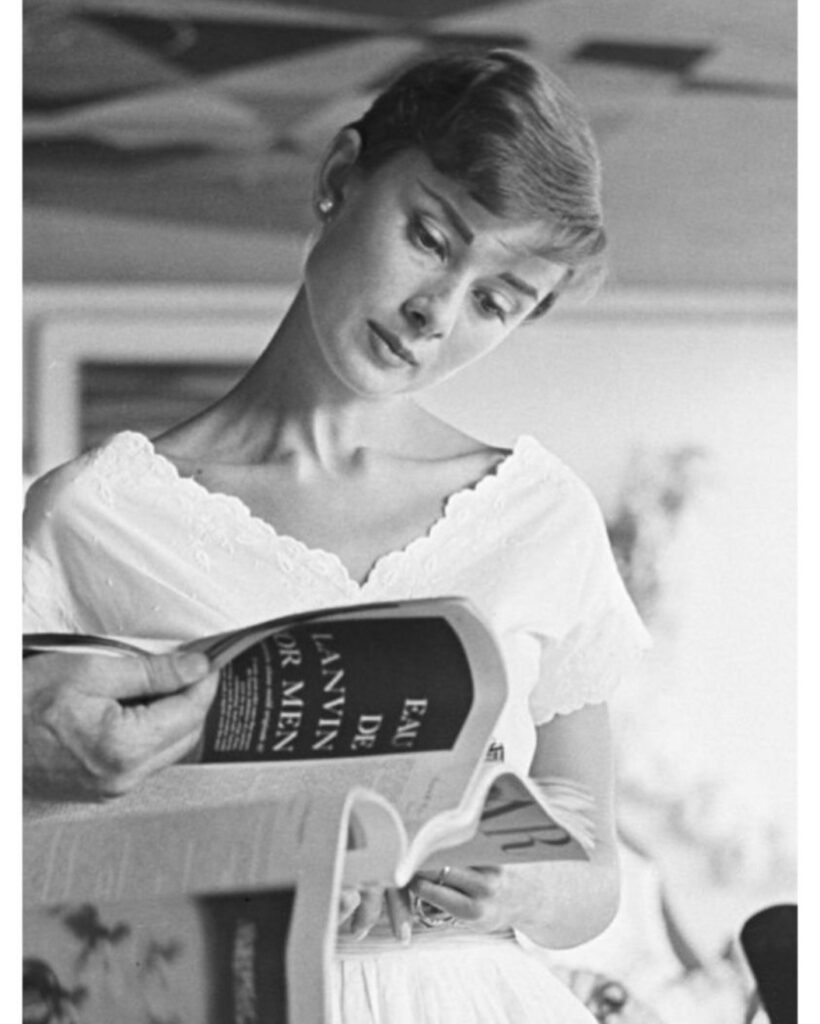
Audrey Hepburn remains one of the most recognizable names in classic Hollywood.
She is remembered for her elegance, her expressive face, and her rare ability to look both glamorous and deeply human.
Yet her story is bigger than cinema.
It is also a story about war, resilience, craft, fame, privacy, and a long second life of service.
This blog post explores Audrey Hepburn as a performer and as a cultural symbol.
It also looks at why her image still sells style, why her acting still works, and why her humanitarian work deserves more than a footnote.
Audrey Hepburn: Why She Still Matters
Audrey Hepburn is not just a “classic star.”
She is a lasting reference point for fashion, film, and modern celebrity branding.
Her influence shows up everywhere.
You see it in “little black dress” marketing, in modern romantic-comedy framing, and in editorial photography that borrows her clean lines and soft light.
Her continuing popularity is also SEO-proof.
Search trends around “Audrey Hepburn style,” “Breakfast at Tiffany’s,” and “Audrey Hepburn quotes” have stayed strong for years.
But popularity alone is not the reason she matters.
She matters because her screen presence brought a new kind of femininity to mainstream film.
It was graceful without being passive.
It was vulnerable without being weak.
Her performances often balance charm with sharp self-awareness.
That combination is still rare.
Early Life: War, Discipline, and a Dancer’s Foundation
Audrey Hepburn was born Audrey Kathleen Ruston in 1929.
Her early life was shaped by Europe in crisis.
She spent much of her youth in the Netherlands during the Second World War.
That experience left lasting marks on her health and worldview.
She trained in ballet as a young woman.
Dance gave her posture, timing, physical storytelling, and the discipline that later made her look “effortless” on camera.
The idea that she was simply a natural is a myth.
A lot of her magic was trained into her body.
This dancer’s foundation explains why she could hold still and still feel alive.
It also explains why she could move across a set as if the camera were following choreography.
If you want a quick overview of her filmography in one place, you can explore her credits on IMDb.
That single scroll shows how quickly she moved from newcomer to top-billed star.
The Breakthrough: From Stage to Screen
Audrey Hepburn’s international breakthrough arrived with Roman Holiday (1953).
The role demanded comedy, sincerity, and romantic tension without melodrama.
She delivered all three.
Her Princess Ann is sheltered but not stupid.
She is curious but cautious.
She is playful but aware of consequence.
The performance won her an Academy Award for Best Actress.
It also positioned her as a new kind of leading lady for the 1950s.
She was not built like the typical studio “bombshell.”
She was presented as modern, bright, and emotionally readable.
That mattered to audiences who wanted something fresh.
It also mattered to studios who realized a new star archetype could sell tickets.
Audrey Hepburn’s Acting Style: Lightness With Precision
Audrey Hepburn’s acting looks simple.
That is why it is easy to underestimate.
Her technique often relies on clarity.
She communicates thought before dialogue.
She reacts in micro-movements.
Her eyes frequently do the heavy lifting.
She also had excellent comedic timing.
Many of her funniest moments are built around restraint rather than exaggeration.
A key part of her appeal is tonal balance.
She can be funny without mocking the scene.
She can be romantic without turning sentimental.
She can be sad without turning bleak.
This control is one reason her films remain rewatchable.
They rarely feel “performed at” the viewer.
They feel lived-in.
That is hard to fake.
Defining Films: The Roles That Built the Legend
Audrey Hepburn’s best films are not all the same genre.
That variety is part of her legacy.
Below are a few defining titles.
Each one shows a different strength.
Roman Holiday (1953): Star-Making Charm
Roman Holiday sells fantasy.
It also sells character.
The romance works because it has limits.
The ending respects the story’s logic.
Audrey Hepburn makes the fairytale believable.
She also makes the goodbye hurt without overplaying it.
If you are discovering classic cinema, this is an ideal starting point.
It is accessible, funny, and emotionally clean.
Sabrina (1954): Transformation Without Losing the Person
In Sabrina, the surface plot is makeover and romance.
The deeper plot is identity.
Audrey Hepburn plays transformation as a shift in confidence rather than a costume trick.
That keeps the character from turning into a cliché.
Her wardrobe in this film is also central to her fashion myth.
It is one of the key points where “Audrey Hepburn style” became a market category.
For readers interested in how fashion and film merged in her career, Givenchy is worth exploring.
Their long creative association is one of the most famous in celebrity fashion history.
Funny Face (1957): Dance, Design, and Self-Parody
Funny Face is visually iconic.
It is also knowingly silly at times.
Audrey Hepburn’s dance training shines here.
Her movement sells the musical numbers with genuine skill.
The film also plays with fashion culture.
That makes it a useful snapshot of how style was marketed in mid-century media.
It is not her deepest role.
It is one of her most “Audrey” roles.
Breakfast at Tiffany’s (1961): Iconic, Complicated, Still Discussed
Breakfast at Tiffany’s is often treated as a fashion postcard.
The black dress, pearls, and updo became a global shorthand for chic.
But the film is more complicated than the posters.
Holly Golightly is charming and anxious at the same time.
She is independent and also running.
She is funny and also lonely.
Audrey Hepburn leans into Holly’s fragility.
That is what keeps the character from being just “cute.”
The movie also has elements that have aged badly.
The most obvious is the racist portrayal of a Japanese character.
That part is not a small issue.
It is a reminder that classic films can be both influential and flawed.
Audrey Hepburn’s performance remains a core reason the film still lands.
But modern viewers are right to critique what should be critiqued.
If you want to compare how the story differs from the original text, you can look up Truman Capote’s work via Penguin Random House.
It helps frame the adaptation choices without turning the discussion into pure nostalgia.
My Fair Lady (1964): Voice, Body, and the Debate Around Dubbing
My Fair Lady is one of her most famous projects.
It is also one of the most debated.
The film used dubbing for some of Eliza Doolittle’s singing.
That decision has fueled discussion about credit, performance ownership, and studio power.
Even with that context, her physical performance is impressive.
Eliza’s transformation is expressed in posture, rhythm, and controlled energy.
Audrey Hepburn also brings warmth to Eliza.
She makes the character’s pride feel earned.
The film is a useful case study.
It shows how a star can be celebrated and still be constrained by industry decisions.
Audrey Hepburn and Fashion: The Birth of a Timeless Brand
Audrey Hepburn’s style is often described as timeless.
That is partly true.
It is also carefully constructed.
It came from collaboration, costuming, and strong visual consistency.
Her look favored clean silhouettes.
It favored simplicity over excess.
It photographed beautifully.
That made it perfect for magazines and marketing.
The “Audrey look” also became a template.
It is still used in modern branding for perfume, jewelry, and bridal fashion.
But there is a flip side.
A strong style can become a cage.
Audrey Hepburn sometimes had to play “Audrey Hepburn” instead of a new character type.
That is the hidden cost of becoming an icon.
If you are interested in how her image circulated through photography and publishing, Vogue is a useful window into fashion storytelling.
It shows how celebrity style becomes a language.
Public Image vs Private Reality: What the Camera Didn’t Show
Audrey Hepburn’s public image is polished.
It is also unusually consistent.
She was marketed as kind, refined, and approachable.
That image was not entirely invented.
Many accounts describe her as courteous and serious about work.
But the private reality included hardship, health struggles, and complicated relationships.
Fame often demands a single story.
Real life rarely fits one story.
This gap is important to remember.
It helps us avoid turning her into a saint or a doll.
A more honest view makes her achievements more impressive.
It also makes her humanitarian work more meaningful.
Humanitarian Work: Audrey Hepburn’s Second Great Career
In later life, Audrey Hepburn became deeply involved with humanitarian work.
She served as a UNICEF Goodwill Ambassador.
This role was not symbolic for her.
She traveled extensively and participated in field missions.
She used her fame as access.
She used her discipline as follow-through.
Her work focused on children facing hunger, poverty, and conflict.
She spoke publicly with urgency but without spectacle.
This part of her legacy has grown stronger over time.
It also reframes the idea of “celebrity influence.”
She did not only represent beauty.
She represented responsibility.
To understand the kind of organization she worked with, you can visit UNICEF.
It provides context for the scale and complexity of the issues she engaged with.
Critical Analysis: What Audrey Hepburn Represents in Culture
Audrey Hepburn’s legacy is often reduced to elegance.
That reduction is convenient.
It sells posters and perfume.
It creates an easy fantasy.
But her cultural meaning is more layered.
She represents a shift in screen femininity.
She represents the globalization of style.
She represents post-war longing for grace and stability.
She also represents how Hollywood can shape a woman’s identity into a product.
That product can outlive the person.
There is also a deeper tension.
Audrey Hepburn is celebrated for being “natural.”
Yet her image was carefully curated.
The truth is not that she was fake.
The truth is that stardom is a craft.
She performed on screen and off screen, as all stars do.
The ethical question is not whether she had an image.
The question is how the world uses that image now.
Are we appreciating her work.
Or are we consuming her as décor.
A healthy fandom can do both with awareness.
That balance keeps admiration from becoming flattening.
The Audrey Hepburn Effect: Influence on Modern Film and Celebrity
Audrey Hepburn’s influence on modern actors is subtle.
It is present in the trend toward minimalism.
It is present in performances that use softness as strength.
It is present in rom-com heroines who are quirky but not cruel.
Her influence also appears in celebrity activism.
Many modern stars cite humanitarian work as part of their public identity.
Audrey Hepburn helped legitimize that path.
She showed that sincerity could exist alongside fame.
Her influence is also commercial.
Search any marketplace and you will find her face on products.
That brings up questions of licensing and legacy management.
It also shows how powerful her image still is.
Iconography is a kind of currency.
Audrey Hepburn remains rich in it.
Visiting Her Films Today: A Simple Watching Guide
If you want to explore Audrey Hepburn without getting overwhelmed, follow a simple order.
Start with heart, then style, then complexity.
Begin with Roman Holiday.
Then watch Sabrina.
Then watch Funny Face.
Then try Breakfast at Tiffany’s with a critical eye.
Finish with My Fair Lady for scale and spectacle.
This path shows her range and the era’s values.
It also helps you see what changed.
And what stayed timeless.
Final Thoughts: More Than a Fashion Icon
Audrey Hepburn endures because she offered something rare.
She made glamour feel human.
She built an acting style on precision.
She built a public life that turned toward service.
She also lived inside a system that shaped women into symbols.
Her story helps us understand both the beauty and the cost of that process.
Watching her today can be pure pleasure.
It can also be a way to think about history, media, and meaning.
That combination is why she still matters.
And why she still shines.

Also Read : Humphrey Bogart