Ethan Hawke: The Gen X Icon Who Never Stopped Evolving.
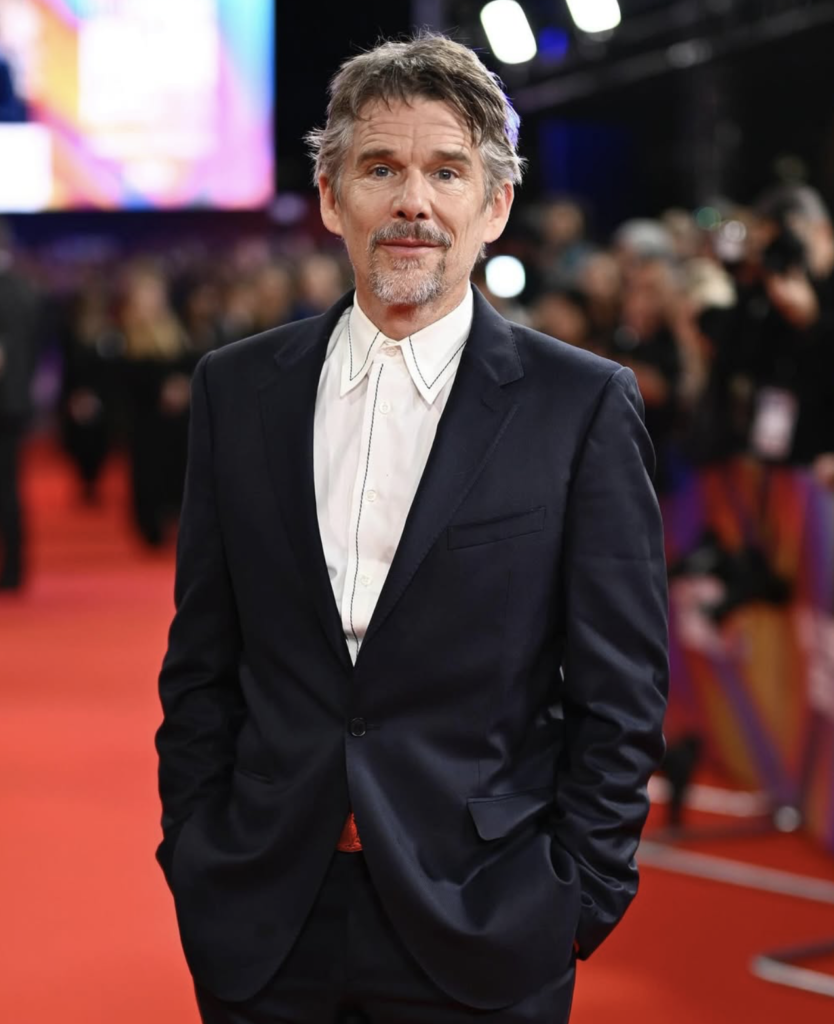
When we talk about Hollywood longevity, few names come up as frequently and as fondly as Ethan Hawke.
He arrived on the scene as a fresh-faced teenager, capturing the angst of a generation.
But unlike many of his contemporaries who faded into obscurity or typecasting, Hawke took a different path.
He chose to become a true artist in every sense of the word.
From blockbuster hits to gritty independent films, his career is a masterclass in versatility.
He is not just an actor; he is a novelist, a director, and a screenwriter.
Today, we dive deep into the life and career of a man who refuses to be defined by a single label.
The Early Years: A Star is Born
Ethan Green Hawke was born on November 6, 1970, in Austin, Texas.
His parents were young when they had him, which perhaps contributed to his bohemian spirit.
After his parents separated, he moved frequently before settling in New Jersey.
This transient lifestyle often fuels the creative fire of many great actors.
He discovered his love for the arts early, attending the prestigious Hun School of Princeton.
It was here that he began to hone the craft that would eventually make him famous.
The Breakthrough: Dead Poets Society
Every actor dreams of that one role that changes everything.
For Hawke, that moment came in 1989 with the film Dead Poets Society.
He played Todd Anderson, a painfully shy student finding his voice.
Playing opposite the legendary Robin Williams was a trial by fire.
The film was a massive critical and commercial success.
It didn’t just launch his career; it defined him as a sensitive, intellectual heartthrob.
Audiences connected deeply with his portrayal of vulnerability.
Suddenly, the world knew who Ethan Hawke was.
He was the face of sensitive youth, a label he would spend years expanding upon.
The 90s: Becoming the Face of Generation X
The 1990s were a strange time for cinema, shifting from 80s gloss to grunge realism.
Hawke fit perfectly into this new aesthetic.
He starred in Reality Bites in 1994 alongside Winona Ryder.
His character, Troy Dyer, was the ultimate slacker philosopher.
He was cynical, unwashed, and undeniably charming.
The film became a cult classic and a touchstone for Generation X.
Critics were divided, but the cultural impact was undeniable.
Hawke proved he could carry a romantic comedy, albeit an unconventional one.
The Linklater Connection: Before Sunrise
If Reality Bites made him a star, Before Sunrise made him an artist.
In 1995, he teamed up with director Richard Linklater.
The film follows an American man and a French woman who meet on a train.
They spend one night walking around Vienna, talking about life and love.
It was a risky project with very little plot and heavy dialogue.
However, the chemistry between Hawke and Julie Delpy was electric.
This film marked the beginning of one of the greatest trilogies in cinema history.
It showcased Hawke’s ability to be natural, charming, and deeply philosophical.
He wasn’t just acting; he was collaborating on the character’s very soul.
The Writer Emerges
Most Hollywood stars are content with just being in front of the camera.
Ethan Hawke, however, had other ambitions.
In 1996, he published his first novel, The Hottest State.
It was a bold move that invited skepticism from literary critics.
People expected a vanity project from a movie star.
Instead, they got a raw, honest look at young love and heartbreak.
He followed it up with Ash Wednesday in 2002.
His writing style is personal, reflective, and unpretentious.
Writing gave him a voice that acting couldn’t always provide.
It allowed him to control the narrative in a way scripts written by others could not.
This literary inclination would later bleed into his screenwriting career.
Examining the Before Trilogy
To understand Ethan Hawke, you must understand the Before trilogy.
Before Sunrise (1995), Before Sunset (2004), and Before Midnight (2013).
These films are unique in the history of cinema.
They follow the same characters over nearly two decades.
Hawke, Delpy, and Linklater wrote the scripts for the second and third films together.
They received Academy Award nominations for Best Adapted Screenplay for both sequels.
This was a rare feat for a romance series.
In Before Sunset, we see the characters dealing with missed opportunities.
In Before Midnight, we see the brutal reality of long-term marriage.
Hawke’s performance evolves from hopeful youth to jaded middle age.
He is unafraid to make his character, Jesse, unlikeable at times.
It is arguably the most realistic depiction of a relationship ever put on film.
These movies cemented his status as an intellectual heavyweight in Hollywood.
Training Day: The Pivot to Intensity
Just as audiences got used to the sensitive intellectual, Hawke switched gears.
In 2001, he starred in Training Day opposite Denzel Washington.
He played Jake Hoyt, a rookie cop on his first day with a corrupt narcotics officer.
It was a gritty, intense, and physically demanding role.
Denzel Washington was a force of nature in the film.
However, Hawke held his own, providing the moral center of the story.
His performance earned him his first Academy Award nomination for Best Supporting Actor.
It proved he could handle action and high-stakes drama.
He wasn’t just the soft-spoken poet anymore; he could be tough.
This role opened doors to more thriller and horror genres later in his career.
navigating the Horror Renaissance
In the 2010s, Hawke made a surprising pivot into the horror genre.
Many prestigious actors avoid horror, viewing it as a step down.
Hawke, however, approached it with the same seriousness as Shakespeare.
He starred in Sinister in 2012.
The film was a massive hit and is often cited as one of the scariest movies ever made.
He played a true-crime writer who uncovers something demonic.
His performance grounded the supernatural elements in reality.
He followed this with The Purge in 2013.
This low-budget thriller became a massive franchise.
Hawke’s presence gave these films a level of credibility they might not have otherwise had.
He proved that horror requires great acting to be truly effective.
Later, in The Black Phone (2021), he played the villain.
It was a terrifying performance that showed yet another side of his range.
The Director’s Chair
Hawke has never been content to just stay in one lane.
He has directed several feature films and documentaries.
His documentary Seymour: An Introduction (2014) is a hidden gem.
It explores the life of pianist Seymour Bernstein.
The film is a meditation on art, stage fright, and living a meaningful life.
It received universal acclaim from critics.
It showed Hawke’s deep empathy and curiosity about the human condition.
Recently, he directed The Last Movie Stars, a docuseries about Paul Newman and Joanne Woodward.
It was a massive undertaking that utilized transcripts of old interviews.
The series was praised for its innovative storytelling structure.
It highlighted Hawke’s respect for the generations of actors who came before him.
He directs with the same sensitivity that he brings to his acting.
Boyhood: A Twelve-Year Commitment
If the Before trilogy was a marathon, Boyhood was an ultramarathon.
Filmed over 12 years from 2002 to 2013, it was a cinematic experiment.
Hawke played the father of the main character, Mason.
We watch him age naturally on screen for over a decade.
There were no prosthetics or CGI used to show aging.
He starts as a somewhat irresponsible dad and matures into a wiser man.
The film is a masterpiece of realism.
It required an immense amount of trust in director Richard Linklater.
Hawke received his fourth Oscar nomination for this role.
It remains one of the most unique projects in Hollywood history.
It perfectly encapsulates Hawke’s career: risky, patient, and deeply human.
The Modern Era: First Reformed and Television
As he entered his late 40s and 50s, Hawke arguably did his best work.
In 2017, he starred in Paul Schrader’s First Reformed.
He played a priest struggling with a crisis of faith and climate anxiety.
It is a quiet, intense, and devastating performance.
Many critics believed he was snubbed for an Oscar nomination.
It showed a maturity and gravitas that only comes with experience.
He also moved into prestige television with The Good Lord Bird.
He created, wrote, and starred in this miniseries about abolitionist John Brown.
His performance was manic, fiery, and absolutely captivating.
It showed his willingness to tackle difficult historical subjects.
He continues to seek out roles that challenge him and the audience.
Personal Life and Public Image
Ethan Hawke has managed to keep a relatively low profile despite his fame.
His marriage to Uma Thurman in the late 90s made them a Hollywood power couple.
They had two children, Maya and Levon, before divorcing in 2005.
The divorce was highly publicized, which Hawke has admitted was difficult.
However, he never let the tabloids define him.
He married Ryan Shawhughes in 2008, and they have two daughters together.
He is known for being a dedicated father.
His daughter, Maya Hawke, has become a star in her own right in Stranger Things.
He often speaks about fatherhood with the same philosophical depth as his art.
He avoids the typical celebrity scandals that plague many of his peers.
This stability has likely allowed him to focus so intensely on his work.
The Philosophy of Ethan Hawke
What sets Ethan Hawke apart is his perspective on fame and art.
He often speaks about acting as a trade, like carpentry.
He doesn’t view himself as a celebrity, but as a working artist.
He is not afraid of failure.
In fact, he embraces it as a necessary part of growth.
He moves seamlessly between Broadway plays and low-budget indie films.
He doesn’t chase box office numbers.
He chases interesting stories and collaborators.
This philosophy has given him a longevity that is rare in the industry.
He understands that if you only do it for the money, you will burn out.
But if you do it for the art, you can go on forever.
Why He Matters Today
In an era of superhero franchises and CGI spectacles, Hawke feels like a throwback.
He reminds us of the power of human connection on screen.
He champions independent cinema and theatrical releases.
He is a mentor to younger actors.
His career serves as a blueprint for how to age gracefully in Hollywood.
He didn’t try to stay 25 forever.
He allowed his face to weather and his voice to deepen.
He allowed his characters to have regrets and back pain.
This authenticity is why audiences still trust him after three decades.
We have grown up with him.
We saw him fall in love in Vienna, fight crime in LA, and question God in upstate New York.
He is the everyman who is also an intellectual.
Critical Analysis of His Acting Style
Hawke is not a chameleon actor like Daniel Day-Lewis.
You always know you are watching Ethan Hawke.
However, this is not a weakness; it is his greatest strength.
He brings his own intelligence and nervous energy to every role.
He is excellent at listening on screen.
Many actors just wait for their turn to speak.
Hawke actually listens to his scene partners.
This makes his reactions feel spontaneous and real.
He uses his voice effectively, often mumbling or stuttering to show uncertainty.
He is not afraid to look weak or foolish.
This vulnerability makes him accessible to the audience.
Whether he is playing a hero or a villain, you understand his motivation.
The Future for Ethan Hawke
So, what is next for this tireless creative force?
He shows no signs of slowing down.
He continues to write, direct, and act in a variety of projects.
He recently directed his daughter Maya in the film Wildcat.
This biographical drama about Flannery O’Connor proves he is still taking risks.
He is also venturing into the world of Marvel with Moon Knight.
Even in a superhero show, he brought a nuanced, philosophical villain to life.
It seems there is no genre he is unwilling to touch.
As long as the character is interesting, Hawke is interested.
We can expect him to continue surprising us for years to come.
Conclusion: The Artist at Work
Ethan Hawke is a rare breed in the entertainment industry.
He survived the perils of child stardom.
He navigated the transition from heartthrob to character actor.
He expanded his horizons to become a respected writer and director.
Through it all, he maintained a level of integrity that is inspiring.
He reminds us that success is not just about fame or money.
It is about longevity, curiosity, and the relentless pursuit of truth.
Whether he is writing a novel or screaming as John Brown, he gives 100%.
He is the Gen X icon who grew up, but never sold out.
And for that, we should all be grateful.
Also Read : Taylor Swift the stylish one