




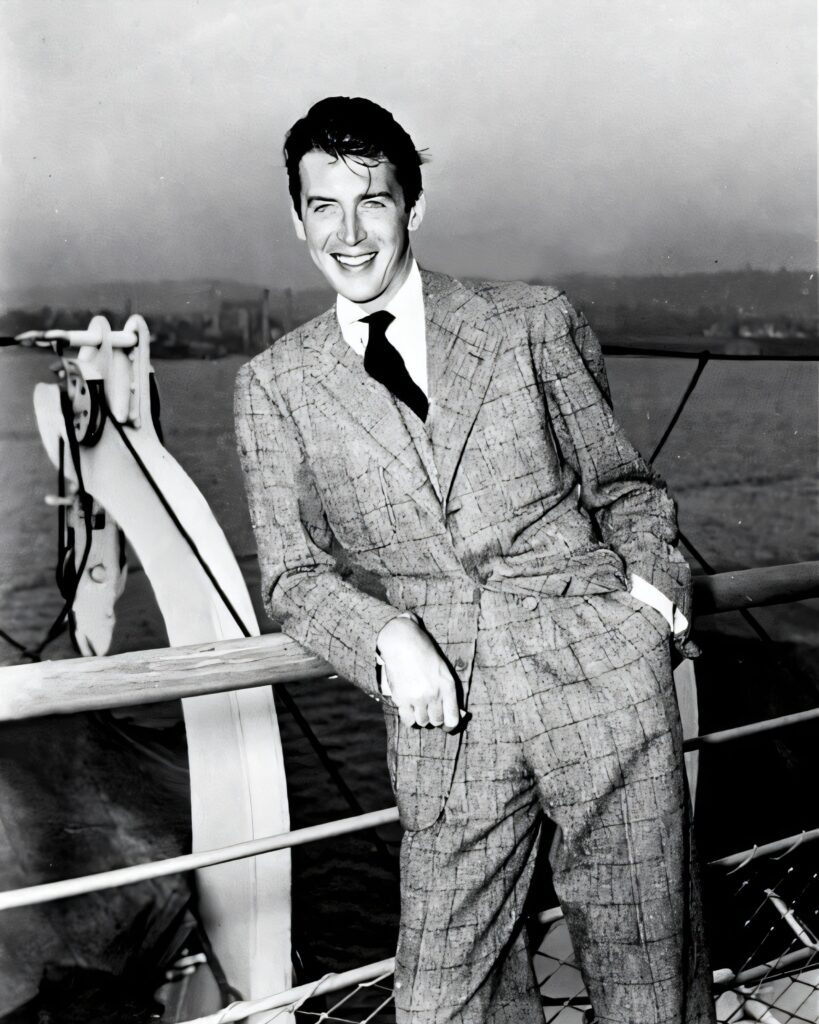
James Stewart remains one of the most recognizable names in classic Hollywood.
He built a career that felt both larger-than-life and strangely personal.
He could play the everyman without ever seeming ordinary.
And he could carry a film with nothing more than a hesitant smile and a trembling pause.
In an era filled with studio-made glamour, Stewart’s appeal looked almost accidental.
That “accident” became his brand.
It also became his legacy.
This blog post explores James Stewart as a star, a craftsperson, and a cultural figure.
It looks at his signature screen style, his most important films, and the contradictions that made him fascinating.
It also shows why his work still plays so well for modern audiences searching for real emotion inside big stories.
Why James Stewart Still Matters
James Stewart matters because he helped define what American sincerity looks like on screen.
His characters often feel like good people trying to stay good under pressure.
That theme is timeless.
He also matters because he changed.
He didn’t stay frozen as a single “type.”
He began as a light, charming romantic lead.
He evolved into something darker and more complicated.
If you want to understand film acting as a bridge between silent-era clarity and modern psychological realism, Stewart is a key stop.
His performances are not loud, but they are intensely readable.
His face becomes the script.
For readers who want a broad view of his filmography, this overview pairs well with the film list at IMDb.
It is also helpful to explore his awards record via the Academy Awards site.
Early Life and the Making of a Screen Persona
James Maitland Stewart was born in 1908 in Indiana, Pennsylvania.
His background was small-town American in a way that later shaped his image.
That image was never only marketing.
It was partly real temperament, partly performance discipline.
He studied architecture at Princeton University.
That detail matters because it hints at how his mind worked.
There is a structural quality to his acting.
He builds scenes rather than merely reacting to them.
Before Hollywood fully claimed him, Stewart worked in theater.
That stage experience trained his timing and his use of stillness.
It also helped him understand audiences as living, breathing partners.
For context on his hometown and early biography, you can compare notes with the summary at Encyclopaedia Britannica.
If you enjoy classic actor biographies, the general timeline approach at TCM can also be useful.
The “Awkward Grace” Style: What Stewart Did Differently
James Stewart’s most famous trait is sometimes called “awkward sincerity.”
That phrase can sound like a criticism.
In Stewart’s hands, it was a superpower.
He didn’t act like a polished hero.
He acted like a person who wanted to be brave and was surprised that bravery was required.
The Voice, the Pause, and the Stumble
Stewart’s voice is a major part of his identity.
It carries hesitation, warmth, and sudden moral force.
He often begins a line softly, then rises into conviction.
His pauses are not empty.
They feel like thinking.
They make the audience lean in.
His stumbles, repeats, and verbal detours look natural.
They also serve story structure.
They allow tension to build without obvious “actor tricks.”
If you want to compare Stewart’s cadence to modern acting ideas, it can help to read basic acting theory at The Actors Studio.
It is not about copying him.
It is about understanding why his rhythm feels honest.
The Face That Could Hold a Whole Scene
Stewart had a face that could register moral conflict in real time.
He didn’t need big gestures.
He could let a close-up do the work.
That skill became crucial when he collaborated with directors who loved psychological tension.
It is one reason his thrillers remain so watchable today.
Breakthrough Years: From Likeable Lead to Serious Star
Stewart’s rise came through a string of roles that framed him as charming, decent, and approachable.
He made audiences feel safe.
Then he began taking parts that made audiences uneasy.
That pivot is part of his genius.
He didn’t destroy his early image.
He complicated it.
Key Films That Built the Stewart Myth
Many films contributed to his legend, but a few are repeatedly central in discussions.
One is Mr. Smith Goes to Washington.
It turned Stewart into a symbol of democratic idealism under attack.
Another is The Philadelphia Story.
It proved he could handle sophisticated comedy without losing his grounded feel.
Then there is It’s a Wonderful Life.
It is often treated as seasonal comfort viewing.
It is also, when watched closely, a tough film about despair and responsibility.
If you want to explore the broader cultural life of these films, the resources and essays at the Library of Congress can be a strong starting point.
It can also help to browse film history material at the British Film Institute.
World War II and the “Real Hero” Dimension
James Stewart is distinct among movie stars because of his real military service.
He served as a pilot in World War II and continued in the military reserves, eventually reaching the rank of brigadier general.
That fact influences how audiences read his screen heroism.
This is not simply trivia.
It changes the emotional contract between actor and audience.
When Stewart plays fear, you believe him.
When he plays duty, it lands differently.
For readers who want historical context on American military aviation, background material from the National Museum of the United States Air Force can add perspective.
General WWII history context is also well covered at the National WWII Museum.
The Hitchcock Era: When Sincerity Turns Dangerous
If early Stewart feels like a warm handshake, Hitchcock-era Stewart can feel like a clenched fist.
His collaborations with Alfred Hitchcock are some of the most discussed actor-director pairings in film history.
They show how Stewart’s decency could be bent into obsession.
Rope: Politeness in a Room Full of Murder
In Rope, Stewart plays a teacher drawn into moral horror.
The setting is controlled and stage-like.
His reactions become the engine.
The performance is a lesson in controlled panic.
He tries to stay rational.
He fails in believable increments.
Rear Window: Curiosity, Voyeurism, and the Audience
Rear Window is often celebrated as a perfect thriller.
It is also a story about watching.
Stewart’s character becomes a stand-in for the viewer.
His charm keeps the audience from feeling accused too early.
Then the film quietly turns the mirror back.
Vertigo: The Darkest Turn
Vertigo is where Stewart’s image truly fractures.
He becomes obsessive, controlling, and emotionally unsteady.
Yet he remains human.
That mix is why the film’s impact lasts.
It is not “good guy versus bad guy.”
It is desire versus sanity.
If you want to explore Hitchcock’s filmmaking context, BFI is helpful.
For deeper film scholarship pathways, you can also browse the film studies sections of JSTOR if you have access.
The Western Years: Morality on the Frontier
Stewart’s Westerns deserve special attention.
They show him as older, tougher, and sometimes haunted.
The genre allowed him to play men shaped by violence.
It also allowed him to keep his essential decency, even when his characters were dangerous.
The Mann-Stewart Films: A Sharper Edge
Stewart worked with director Anthony Mann in a series of Westerns that pushed his persona into harder territory.
These films often place him in landscapes that look like emotional states.
The wide open space becomes a cage.
He is frequently driven by revenge, pride, or buried shame.
And yet he remains understandable.
That balance is difficult.
For a broad overview of Western film history that helps situate this phase, you can explore genre discussions at TCM.
You can also compare his Western output to other eras through film listings and credits on IMDb.
Comedy, Romance, and the Stewart Charm
It is easy to focus on Stewart’s darker work because it feels modern.
But his comedy is essential to why he became a star.
He could be funny without winking at the audience.
He could be romantic without becoming slick.
His charm often came from restraint.
He did not push jokes.
He let situations do the pushing.
That approach is a big reason his romantic comedies still work.
They do not feel like museum pieces.
They feel like human interactions with better dialogue.
Craft and Technique: What Actors Study in James Stewart
Stewart is frequently referenced in acting conversations because his technique is invisible.
It looks like personality.
It is actually control.
He understood listening.
He understood reacting.
He understood the power of understatement.
The “Everyman” That Was Actually Precision
Calling Stewart an “everyman” can be misleading.
An everyman performance can be lazy.
Stewart’s never is.
His emotional beats are placed carefully.
His shifts happen at moments that support the scene’s turn.
His sincerity is shaped like architecture.
The Stewart Lesson: Emotion Without Display
Modern acting often prizes emotional openness.
Stewart shows another path.
He gives emotion through containment.
He makes you feel what he refuses to say.
That skill is especially visible in his dramatic climaxes.
He escalates without exploding too soon.
He holds the center until the story forces release.
Cultural Impact: The Stewart Image and the American Story
James Stewart became an emblem of certain American ideals.
Those ideals include honesty, responsibility, and civic decency.
But his best work also questions those ideals.
That is why his career is richer than nostalgia.
He is not only the symbol of virtue.
He is also the actor who shows how virtue breaks.
His films explore anxiety about institutions, fear of failure, and the loneliness inside public respectability.
Those themes still resonate.
They may resonate even more now.
If you like connecting classic films to larger cultural history, the exhibition essays and collections at the Smithsonian can be a rewarding place to browse.
Essential Viewing Guide (Accessible Entry Points)
If you are new to James Stewart, it helps to start with variety.
Pick one film from each “mode” of his career.
That way you see range rather than repetition.
For Idealism and Classic Hollywood Energy
Try Mr. Smith Goes to Washington.
It shows Stewart as a moral spark in a cynical system.
For Hope and Emotional Complexity
Try It’s a Wonderful Life.
Watch it as a drama first, not a holiday decoration.
For Suspense and Psychological Play
Try Rear Window.
It is thrilling, funny, and unsettling all at once.
For Obsession and Dark Transformation
Try Vertigo.
It is challenging, but it reveals Stewart’s boldest risks.
For a Tougher Frontier Persona
Try one of his major Westerns from the Anthony Mann period.
It highlights the “shadow Stewart” that many casual viewers miss.
To track availability across services, general film discovery tools like JustWatch can help you find where specific titles are streaming in your region.
Criticisms and Honest Limits
A serious look at James Stewart should include limits as well as praise.
Some viewers find his mannerisms repetitive across films.
Some feel his “stammer style” becomes too recognizable once you notice it.
There are also roles that seem built to preserve his image rather than challenge it.
That is partly a studio-era reality.
Stars were products as well as artists.
Still, even when the role is conventional, Stewart’s best moments tend to arrive unexpectedly.
He will add a pause, a look, a slight hurt.
And the character suddenly feels real.
Why He Endures in the SEO Age of “Comfort Viewing”
In today’s algorithm-driven media world, “comfort viewing” is a category.
James Stewart is often filed there.
Yet his best performances are not only comforting.
They are confronting.
He endures because he offers emotional clarity without simplification.
He shows fear without melodrama.
He shows decency without smugness.
He shows darkness without turning into a cartoon villain.
That combination is rare.
It is also why new generations keep discovering him.
For readers exploring classic Hollywood beyond Stewart, the broader catalogs and essays at TCM and the BFI can guide further watching.
Final Thoughts on James Stewart
James Stewart was not simply a star of old movies.
He was a master of screen intimacy.
He understood that the camera rewards truth more than volume.
His career maps a journey from innocence to experience.
It also maps the evolution of American film itself.
From optimistic civics to psychological unease, Stewart is there, changing with the culture.
If you want a single reason to revisit him, make it this.
His performances still feel like a person thinking in real time.
That illusion is the heart of movie acting.
Also Read : Audrey Hepburn